


Table of contents
- Why multi-vehicle collisions are complex
- How Colorado comparative negligence may apply
- Fault may be assigned by percentage
- A claimant’s recovery may be reduced
- Recovery may be barred in some cases
- Evidence used to evaluate fault
- Police reports and scene documentation
- Vehicle damage and accident reconstruction
- Digital evidence
- Witness statements
- Common multi-vehicle crash scenarios
- Scenario 1: The push-through collision
- Scenario 2: Multiple initial impacts
- Scenario 3: Adverse weather and unsafe speed
- Steps to take after a multi-vehicle accident in Colorado Springs
- Protect your rights after a complex collision
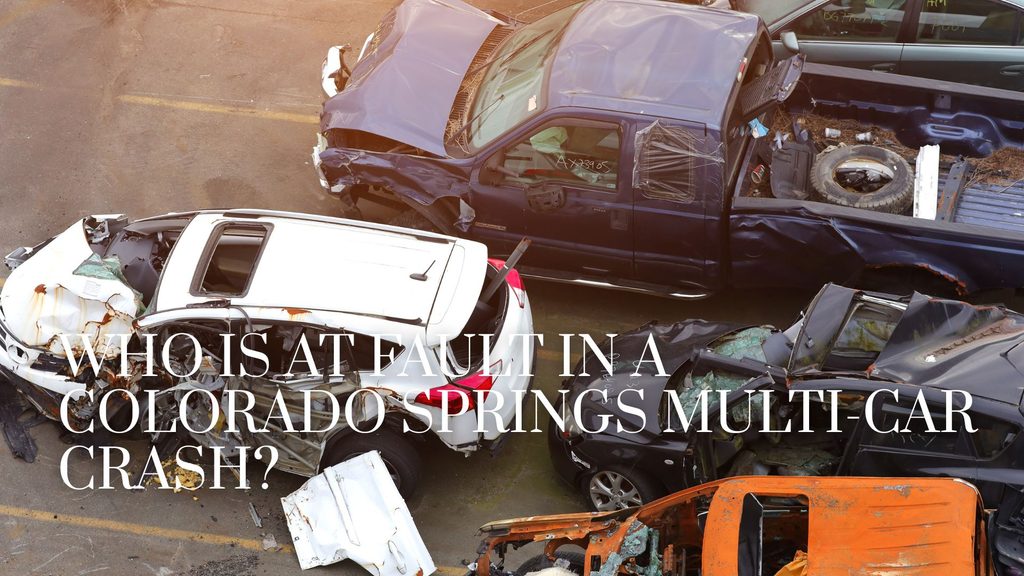
A chain-reaction crash on I-25, Highway 24, or Powers Boulevard can become chaotic within seconds. Congestion, sudden stops, winter weather, reduced visibility, icy roads, and high speeds can all contribute to multi-vehicle collisions in the Colorado Springs area.
While a two-vehicle collision may sometimes be easier to investigate, a pileup involving three, four, or more vehicles can raise complicated questions about fault. When several drivers, vehicles, and insurers are involved, determining responsibility for injuries, vehicle damage, and other losses often requires a careful review of the sequence of impacts and the available evidence.
This overview explains how comparative negligence may apply in Colorado multi-vehicle accidents and what evidence may help evaluate liability after a chain-reaction crash.
Why multi-vehicle collisions are complex
In a basic rear-end crash, the rear driver’s conduct may be important evidence. However, a rear-end impact does not automatically establish fault. The sequence of events, road conditions, vehicle spacing, speed, braking, visibility, and prior impacts can all affect the analysis.
Colorado law requires drivers not to follow another vehicle more closely than is reasonable and prudent under the speed, traffic, and highway conditions present at the time. Colorado law also requires drivers to reduce speed when a special hazard exists because of weather, highway conditions, pedestrians, or other traffic.
Drivers in chain-reaction crashes may experience multiple impacts, making it difficult to identify which collision happened first and how each vehicle moved afterward.
Questions in a multi-vehicle crash investigation may include:
- Did Vehicle A stop safely before impact?
- Did Vehicle B strike Vehicle A before Vehicle C hit Vehicle B?
- Was Vehicle B pushed into Vehicle A by the force of another vehicle’s impact?
- Did one or more drivers follow too closely, travel too fast for conditions, drive while distracted, or fail to react to stopped traffic?
- Did road conditions, weather, a vehicle issue, reduced visibility, or another factor contribute to the crash?
- Did one impact cause or worsen later damage or injuries?
Several insurance companies may investigate the same collision. Their conclusions can differ, especially when more than one driver may share responsibility.
How Colorado comparative negligence may apply
Colorado follows a modified comparative negligence rule under C.R.S. § 13-21-111. More than one person may be found responsible for a crash, and an injured person’s own conduct may affect the damages they can recover.
Fault may be assigned by percentage
Insurance companies may take initial positions on fault while evaluating a claim. If a case proceeds to litigation, a judge or jury may determine the degree of negligence attributable to each party based on the evidence.
For example, one driver may be found primarily responsible for initiating a collision, while another driver may be assigned a share of fault for following too closely, traveling too fast for conditions, failing to maintain a proper lookout, or taking another unreasonable action.
A claimant’s recovery may be reduced
If an injured claimant is found partially at fault, any damages awarded may be reduced by that percentage.
For example, if total damages are $100,000 and a claimant is found 10% at fault, the damages may be reduced by $10,000, leaving a potential recovery of $90,000, assuming the claimant remains legally eligible to recover under Colorado law.
Recovery may be barred in some cases
A claimant may be barred from recovery if their negligence is equal to or greater than the combined negligence of the person or persons against whom recovery is sought.
This is often described as Colorado’s modified comparative negligence rule. How it applies in a particular multi-vehicle crash can depend on the parties involved, the claims asserted, the available evidence, and how fault is allocated.
Evidence used to evaluate fault
A multi-vehicle crash claim may depend on evidence that helps establish the sequence, force, timing, and circumstances of each impact.
Police reports and scene documentation
Law enforcement may document the crash scene, note road and weather conditions, interview drivers and witnesses, record vehicle positions, and issue citations when appropriate. The responding agency can vary depending on where the collision occurred.
Colorado law requires drivers involved in a qualifying traffic accident to provide immediate notice to the proper law-enforcement authority. If someone is injured, there is a serious safety hazard, or emergency assistance is needed, call 911.
If an officer was not called to the scene, a driver may be able to file a report through Colorado’s online crash-reporting system. An individual-filed online report is not investigated by law enforcement and is commonly referred to as a counter report. Eligibility and reporting requirements can vary, so drivers should review the current state instructions or speak with the agency having jurisdiction.
Vehicle damage and accident reconstruction
Damage patterns, crush depth, paint transfer, vehicle positions, tire marks, debris fields, roadway evidence, and other physical evidence may help qualified accident-reconstruction professionals evaluate the sequence and mechanics of impacts.
In a chain-reaction collision, physical evidence may help distinguish between a vehicle that independently rear-ended another car and a vehicle that was pushed into another car after being struck from behind.
Digital evidence
Depending on the vehicle and crash, an event data recorder may contain information relevant to the collision, such as certain speed, braking, steering, restraint, or crash-event data. The type and amount of available data vary by vehicle.
In Colorado, event-data-recorder information is subject to legal access restrictions. Obtaining or releasing data may require owner consent, formal civil discovery, a court order, or another authorized process.
Other potentially useful evidence may include:
- Dashcam footage
- Traffic-camera video
- Nearby business or residential surveillance video
- Cellphone photographs and video
- Vehicle telematics or app data, when available
- Dispatch or 911 records
- Witness statements
- Vehicle repair estimates and photographs
Witness statements
Statements from uninvolved witnesses, passengers, first responders, and nearby drivers may help clarify the sequence of events. Because memories can fade, preserving names, contact information, and factual observations as soon as practical may be helpful.
Common multi-vehicle crash scenarios
Scenario 1: The push-through collision
Vehicle A stops behind traffic. Vehicle B stops behind Vehicle A. Vehicle C fails to stop and strikes Vehicle B, pushing Vehicle B into Vehicle A.
In this situation, Vehicle C may bear primary responsibility if the available evidence shows that its impact caused Vehicle B to strike Vehicle A. The final fault analysis may still depend on evidence about each driver’s conduct, vehicle spacing, roadway conditions, and the timing of each impact.
Scenario 2: Multiple initial impacts
Vehicle B rear-ends Vehicle A. Shortly afterward, Vehicle C hits Vehicle B from behind.
Fault may be divided between Vehicle B and Vehicle C. Vehicle B may be responsible for the initial impact with Vehicle A, while Vehicle C may be responsible for additional injuries or property damage if its later impact worsened the collision. Medical evidence and accident-reconstruction evidence may be important when evaluating injuries or damage caused by separate impacts.
Scenario 3: Adverse weather and unsafe speed
During winter conditions on I-25 or another Colorado Springs roadway, several drivers travel too fast for icy or snow-covered roads. One vehicle loses control, and multiple following vehicles collide.
Fault may be distributed among one or more drivers depending on whether they maintained a reasonable speed, left adequate following distance, maintained a proper lookout, or responded reasonably to the conditions.
Steps to take after a multi-vehicle accident in Colorado Springs
If you are involved in a chain-reaction collision, prioritize safety and take reasonable steps to preserve information.
- Call 911 and report the crash when emergency help is needed, someone may be injured, or there is a hazard at the scene. If you can move to a safe location without creating additional danger, do so.
- Seek medical attention when needed. Get emergency care for urgent symptoms and consider prompt medical evaluation if you are injured or develop symptoms after the crash. Some injuries may not be immediately apparent.
- Document the scene if it is safe. Take photographs or video of the vehicles, license plates, road surface, weather conditions, traffic layout, debris, visible damage, and relevant signs or signals.
- Exchange required information. Obtain the names, contact details, insurance information, license information, and vehicle details for each involved driver when possible.
- Provide accurate, factual information to law enforcement and emergency personnel. Avoid guessing about the sequence of events, speculating about fault, or making statements beyond what you personally observed.
- Preserve evidence. Save photographs, medical records, repair estimates, witness information, insurance correspondence, and available video. If a vehicle is heavily damaged, discuss preservation of photographs, repair estimates, and potentially relevant physical evidence with your insurer or an attorney before authorizing repairs, salvage, or disposal, when practical and safe to do so.
- Consider speaking with a personal injury attorney. A lawyer can evaluate the facts, explain potential deadlines, communicate with insurers, and help preserve evidence in a complex claim.
Protect your rights after a complex collision
Insurance claims after a multi-vehicle crash can become complicated when several insurers and drivers dispute responsibility. The evidence, order of impacts, severity of injuries, available insurance coverage, and conduct of each driver can all affect the claim.
If you or a loved one was injured in a chain-reaction crash in Colorado Springs or the surrounding area, Matlin Injury Law’s Colorado Springs car accident lawyers can review the circumstances of your case. The firm states that it offers a free consultation and case review for people injured in Colorado Springs car accidents.
For additional information about Colorado accident claims, you can also review Matlin Injury Law’s Colorado accident and personal injury claim guide.
If you need guidance after a multi-vehicle accident, contact Matlin Injury Law to request a free consultation and discuss your situation.